What is islam

The word “Islam” is an Arabic word which means “submission to the will of God”. This word comes from the same root as the Arabic word “salam”, which means “peace”.

The Prophet Muhammad Peace be upon him

The mission of the last and final prophet of God was to simply teach that “there is nothing divine or worthy of being worshipped except for Almighty God”, as well as being a living example of God’s revelation. In simple terms, God sent the revelation to Muhammad, who in turn taught it, preached it, lived it and put it into practice.

The Holly Quran

The Arabic world “Al-Quran” literally means “the recitation”. When used in regards to Islam, the word Quran means God’s final message to mankind, which was revealed to the Prophet Muhammad. The Quran, sometimes spelled Koran, is the literal the word of God - as it clearly says time and time again.

The Oneness of God

The foundation of the Islamic faith is belief in the Oneness of Almighty God - the God of Abraham, Noah, Moses and Jesus. Islam teaches that a pure belief in One God is intuitive in human beings and thus fulfils the natural inclination of the soul

Islam for a Better Life

Islam teaches that true happiness can only be obtained by living a life full of God-consciousness and being satisfied with what God has given us.

Affichage des articles dont le libellé est Pillar of islam. Afficher tous les articles

dimanche 16 mars 2014

Who does qualify to receive Zakat?


He has raised some of you in ranks above others that He may try you in the gifts He has given you.” (Quran 6:165)
Zakat has both humanitarian and socio-political value.  It is designed by our Creator to redistribute wealth and encourage social responsibility.  When Zakat is collected and distributed correctly it minimises the needs of citizens to such an extent that there may be no poor or needy within the Muslim community.   It has been reported and documented that at certain times in Islamic history no person, of any religion, who lived in the Islamic Empire qualified to receive Zakat.  There was enough money and wealth circulating to ensure a fair standard of living for everybody.
 So who does qualify to receive Zakat? God has ordained that the Zakat be distributed to certain categories of people.


“The alms are only for the poor, and the needy and those employed to collect the funds; and to attract the hearts of those who have been inclined towards Islam; and to free the captives; and for those in debt; and for those struggling for the cause of God, and for the wayfarer (a traveller who is cut off from everything); a duty imposed by God.” (Quran 9:60)

God mentions eight (8) categories of people.

1.      The poor - those who can meet basic needs but have neither wealth or secure livelihood.

2.      The needy – the extremely poor who cannot meet even basic needs.

3.      Those persons who are appointed to collect Zakat; (regardless of personal wealth).

4.      Those who have recently converted or are considering converting to Islam.

5.      Zakat may be used to purchase the freedom of slaves.

6.      A person whose debts exceed his assets.

7.      Those who are away from home working in the path of God.

8.      A traveller, who is stranded and in need of financial assistance.

If a person has enough wealth to be a contributor he is not able to be a recipient.  Zakat may be distributed directly to individuals, or it may be entrusted to an Islamic welfare organisation or association, to be distributed at their discretion to those who are deserving.

A contributor should not seek fame or praise for carrying out what is an Islamic duty.  In fact he should give the Zakat as covertly as possible so as not to become proud or arrogant, thus nullifying his good deed.  Under certain circumstances however, the disclosure of contributions may encourage others to be generous.


Islam is a religion that encourages generosity and Zakat is just one way of encouraging  this in our everyday lives.  One of the most important principles of Islam is that all things belong to God, wealth therefore is only for our benefit to use for our needs and to distribute.  In terms of the way we look at the world in the 21st century Zakat could be considered a permissible form of insurance.  One who pays or receives the Zakat in a permissible and honourable way will gain many benefits including God’s pleasure, forgiveness and blessings.  In the traditions of Prophet Muhammad we are reminded that giving charity stands in the way of calamity[1].

“The parable of those who spend their wealth in the way of God is that of a grain of corn.  It grows seven ears and each ear has hundred grains.  God increases manifold to whom He pleases.” (Quran 2:261)

Footnotes:
[1] At Tirmidhi

Zakat – Obligatory Charity


In the glossary of The Noble Quran[1]  the term Zakat is defined as follows, “A certain fixed proportion of the wealth and of every property liable to Zakat of a Muslim to be paid yearly for the benefit of the poor in the Muslim community.  The payment of Zakat is obligatory as it is one of the five pillars of Islam.  Zakat is the major economic means for establishing social justice and leading the Muslim society to prosperity and security”.

Thus we can see that Zakat is not a tax levied by a government nor is it a voluntary contribution to a charity.  It is a command enjoined upon the Muslims by God and as such it is a form of worship.  In fact it is worship of such a high and commendable standard that in the Quran it is frequently coupled with prayer.  Prayer is an act of worship through words and action while Zakat is an act of worship involving wealth.

“Lo! Those who believe and do good deeds and establish salat and pay zakat, their reward is with their Sustainer; and no fear shall come upon them, nor shall they grieve.” (Quran 2:277)

“These are verses of the Book full of wisdom, a guide and mercy to the doers of good -those who establish salat and pay zakat and have the assurance of the Hereafter.” (Quran 31:4)

Zakat, one of the five pillars of Islam, thus one of the basic foundations of the religion, is assessed once per year and is obligated upon those Muslims, men and women, who possess means enough to distribute a certain calculated percentage to the poor and needy.  As with many words used by God in the Quran, the word Zakat has many layers of meaning.  It can be translated to obligatory charity, alms, or tithe; however it combines these meanings with a deeper richer meaning of purity.

Giving Zakat purifies the heart of the one who gives from selfishness and greed for wealth, and develops in him sympathy for the poor and needy.  For those who receive the Zakat, it purifies the heart from envy and hatred of the rich and prosperous, and fosters a sense of good will between brothers.  
Zakat has a deep spiritual significance as well as an economic objective.

Muslims believe God is the true Owner of all things and we, human beings, are merely trustees.  Wealth should be produced, distributed, acquired and spent in a way which is pleasing to God.  Every Muslim considers his condition in this world as a test from God.  Those with wealth have the obligation to be generous and charitable, those without have the obligation to be patient, to work to improve their situation, and to be free of envy.  God emphasises that it is not a person’s wealth but his piety, character and manners that determine his ultimate place in the hereafter.


“He grants abundant sustenance, or gives it in scant measure, unto whomever He wills, for He knows full well all things.” (Quran 42:12)

Footnotes:
[1] Interpretations of the meanings of The Noble Quran in the English language, by Dr Muhammad Taqi-ud-Din Al Hilali & Dr Muhammad Mushin Khan.

The concept of wealth in Islam


“Man’, said the Prophet, ‘says: My wealth!  My wealth!’  Have you not any wealth except that which you give as alms and thus preserve, wear and tatter, eat and use up?”
The whole concept of wealth is considered in Islam as a gift from God.  God, who provided it to the person, made a portion of it for the poor, so the poor have a right over one’s wealth.  Zakat reminds Muslims that everything they have belongs to God.  People are given their wealth as a trust from God, and zakat is intended to free Muslims from the love of money.  The money paid in zakat is not something God needs or receives.  

He is above any type of dependency.  God, in His boundless mercy, promises rewards for helping those in need with one basic condition that zakat be paid in the name of God; one should not expect or demand any worldly gains from the beneficiaries nor aim at making one’s names as a philanthropist.  The feelings of a beneficiary should not be hurt by making him feel inferior or reminding him of the assistance.
Money given as zakat can only be used for certain specific things.  Islamic Law stipulates that alms are to be used to support the poor and the needy, to free slaves and debtors, as specifically mentioned in the Quran (9:60).  Zakat, which developed fourteen hundred years ago, functions as a form of social security in a Muslim society.
Neither Jewish nor Christian scriptures praise slave manumission by raising it to worship. Indeed, Islam is unique in world religions in requiring the faithful to financially help slaves win their freedom and has raised the manumission of a slave to an act of worship - if it is done to please God.
Under the caliphates, the collection and expenditure of zakat was a function of the state.  In the contemporary Muslim world, it has been left up to the individual, except in some countries in which the state fulfills that role to some degree.  Most Muslims in the West disperse zakat through Islamic charities, mosques, or directly giving to the poor.  Money is not collected during religious services or via collection plates, but some mosques keep a drop box for those who wish it to distribute zakat on their behalf.  Unlike the zakat, Giving other forms of charity in private, even in secret, is considered better, in order to keep one’s intention purely for the God.

Apart from zakat, the Quran and Hadeeth (sayings and actions of the Prophet Muhammad, may the mercy and blessings of God be upon him) also stresssadaqah, or voluntary almsgiving, which is intended for the needy.  The Quran emphasizes feeding the hungry, clothing the naked, helping those who are in need, and the more one helps, the more God helps the person, and the more one gives, the more God gives the person.  One feels he is taking care of others and God is taking care of him.

The Third Pillar of Islam: Charity


Charity is not just recommended by Islam, it is required of every financially stable Muslim. 
Giving charity to those who deserve it is part of Muslim character and one of the Five Pillars of Islamic practice.  Zakat is viewed as “compulsory charity”; it is an obligation for those who have received their wealth from God to respond to those members of the community in need.  Devoid of sentiments of universal love, some people know only to hoard wealth and to add to it by lending it out on interest.  Islam’s teachings are the very antithesis of this attitude.  Islam encourages the sharing of wealth with others and helps people to stand on their own and become productive members of the society.


In Arabic it is known as zakat which literally means “purification”, because zakat is considered to purify one’s heart of greed.  Love of wealth is natural and it takes firm belief in God for a person to part with some of his wealth.  Zakat must be paid on different categories of property — gold, silver, money; livestock; agricultural produce; and business commodities — and is payable each year after one year’s possession.  It requires an annual contribution of 2.5 percent of an individual’s wealth and assets.

Like prayer, which is both an individual and communal responsibility, zakat expresses a Muslim’s worship of and thanksgiving to God by supporting those in need.  In Islam, the true owner of things is not man, but God.  Acquisition of wealth for its own sake, or so that it may increase a man’s worth, is condemned.  Mere acquisition of wealth counts for nothing in the sight of God.  It does not give man any merit in this life or in the hereafter.  Islam teaches that people should acquire wealth with the intention of spending it on their own needs and the needs of others.


vendredi 7 mars 2014

Importance of Prayer in Islam


The importance of the prayer in Islam cannot be understated.  It is the first pillar ofIslam that the Prophet, may the mercy and blessings of God be upon him, mentioned after mentioning the Testimony of Faith, by which one becomes a Muslim.  It was made obligatory upon all the prophets and for all peoples.  God has declared its obligatory status under majestic circumstances.  For example, when God spoke directly to Moses, He said,

“And I have chosen you, so listen to that which is inspired to you.  Verily, I am God! There is none worthy of worship but I, so worship Me and offer prayer perfectly for My remembrance.” (Quran 20:13-14)


Similarly, the prayers were made obligatory upon the Prophet Muhammad during his ascension to heaven.  Furthermore, when God praises the believers, such as in the beginning of the chapter entitled ‘al-Muminoon’ (the Believers), one of the first descriptions He states is their adherence to the prayers.

Once a man asked the Prophet about the most virtuous deed.  The Prophet stated that the most virtuous deed is the prayer.  The man asked again and again and for the first three times, the Prophet answered, “The prayer,” then on the fourth occasion he stated, “Jihad in the way of God.”[1]

The importance of prayer is demonstrated in many of the Prophet’s statements.  For example, the Prophet said,

“The first matter that the slave will be brought to account for on the Day of Judgment is the prayer.  If it is sound, then the rest of his deeds will be sound.  And if it is incomplete, then the rest of his deeds will be incomplete.”[2]

The importance of the prayers lies in the fact that no matter what actions one performs in his life, the most important aspect is one’s relationship to God, that is, one’s faith (imaan), God-consciousness (taqwa), sincerity (ikhlas) and worship of God (ibaadah).  This relationship with God is both demonstrated and put into practice, as well as improved and increased, by the prayer.  Therefore, if the prayers are sound and proper, the rest of the deeds will be sound and proper; and if the prayers are not sound and proper, then the rest of the deeds will not be sound and proper, as the Prophet himself stated.

In reality, the prayer is performed properly – with true remembrance of God and turning to Him for forgiveness – it will have a lasting effect on the person.  After he finishes the prayer, his heart will be filled with the remembrance of God.  He will be fearful as well as hopeful of God.  After that experience, he will not want to move from that lofty position to one wherein he disobeys God.  God has mentioned this aspect of the prayer when He has said,

“Verily, the prayer keeps one from the great sins and evil deeds” (Quran 29:45)

Nadwi has described this effect in the following eloquent way,

Its aim is to generate within the subliminal self of man such spiritual power, light of faith and awareness of God as can enable him to strive successfully against all kinds of evils and temptations and remain steadfast at times of trial and adversity and protect himself against the weakness of the flesh and the mischief of immoderate appetites.[3]

The overall affect that the properly performed prayers should have upon humans is described in other verses in the Quran:

“Verily, man was created impatient, irritable when evil touches him and ungenerous when good touches him.  Except for those devoted to prayer those who remain constant in their prayers…” (Quran 70:19-23)


As for the Hereafter, God’s forgiveness and pleasure is closely related to the prayers.  The Messenger of God said,

“God has obligated five prayers.  Whoever excellently performs their ablutions, prays them in their proper times, completes their bows, prostrations and khushu[4], has a promise from God that He will forgive him.  And whoever does not do that has no promise from God.  He may either forgive him or punish him.”

The prayers are a type of purification for a human being.  He turns and meets with his Lord five times a day.  As alluded to above, this repeated standing in front of God should keep the person from doing sinful acts during the day.  Furthermore, it should also be a time of remorse and repentance, such that he earnestly asks God for forgiveness for those sins that he committed.  In addition, the prayer in itself is a good deed that wipes away some of the evil deeds that he performed.  These points can be noted in the following hadith of the Prophet, may the mercy and blessings of God be upon him:

“If a person had a stream outside his door and he bathed in it five times a day, do you think he would have any filth left on him?” The people said, “No filth would remain on him whatsoever.” The Prophet then said, “That is like the five daily prayers: God wipes away the sins by them.” (Saheeh Al-Bukhari, Saheeh Muslim)

In another hadith, the Prophet said,

“The five daily prayers and the Friday Prayer until the Friday prayer are expiation for what is between them.” (Saheeh Muslim)

----------------------------------------------
[1] This is form a hadith recorded by Ahmad and ibn Hibban.  According to al-Albani, the hadith is hasan.  Muhammad Nasir al-Din al-Albani, Sahih al-Targheeb wa al-Tarheeb (Beirut: al-Maktab al-Islami, 1982), vol.  1, p.  150
[2] Recorded by al-Tabarani.  According to al-Albani, it is Sahih.  Al-Albani, Sahih al-Jami, vol.1, p.  503.
[3] Nadwi, p. 24

[4] Khushu` in the prayer is where the person’s heart is attuned to the prayer.  This feeling in the heart is then reflected on the body.  The person remains still and calm.  His gaze is also lowered.  Even his voice is affected by this feeling in the heart.  For more details on this concept (as well as the difference between it and khudhu`), see Muhammad al-Shaayi, al-Furooq al-Laughawiyyah wa Atharahaa fi Tafseer al-Quran al-Kareem (Riyadh: Maktabah al-Ubaikaan, 1993), pp.  249-254.  

Prayer in Islam


Five times!  When some hear this, they throw their hands up in horror and wonder about the amount of time this must take and how it can be slotted into one 24 hr period.  Others, who are used to communicating with God in their own form of prayer will often question the rules and regulations that are attached to prayer in Islam.  God, they say, is accessible at any time.  According to Muslim belief that is correct.  God is accessible at anytime and in any place.  Muslims call on God frequently throughout the day and night.  They raise their hands in supplication and ask for His help, mercy, and forgiveness.

This, however, is not the act that Muslims refer to as prayer.  This is called making dua (supplications) and it is similar to Christian prayer in that it is calling on God, asking for His help and  acknowledging His greatness.  For Muslims prayer denotes a set of ritual movements and words said throughout fixed times in a day and night.  God says in Quran, “Verily, the prayer is enjoined on the believers at fixed hours”.  (Quran 4:103)  Muslims pray in the early morning before sunrise, in the middle of the day, in the afternoon, at sunset and at night.  Muslims pray in obedience to God because they believe God created humankind for no other purpose except to worship Him.
“And I did not create man...except to worship Me Alone” (Quran 51:56)
Consequently, for a believer, worship is a way of life.  Prayer at fixed times  serves as a reminder of why we are here and helps to direct a person’s thoughts and actions away from sin and onto remembrance of God.  Prophet Muhammad emphasized the importance of prayer when he explained its ability to remove sin.  He said, “What would you think if there was a river by the door of any one of you and he bathed in it five times a day, would there be any trace of dirt left on him?”  They said, “No trace of dirt would be left on him.”  He said, “That is like the five daily prayers, by means of which God erases sin.”
Saheeh Al-Bukhari and Saheeh Muslim
Prayer is just one act amongst many acts of worship however;
 it holds a very special status in Islam because of the way it was enjoined.  It was not brought down to earth by an Angel rather it was bestowed upon Prophet Muhammad during his unique ascension into the heavens.  Fifty prayers were first enjoined upon the believers but this was eventually reduced to five, while the reward for prayer remains as if it were still fifty.  This reduction shows just how great God’s love for humanity is, a few minutes throughout the day is rewarded as if it were continuous worship.
In prostration, when the forehead touches the ground, the believer is closer to God than at any other time.  There is now an opportunity to make supplication, asking God for help, mercy or forgiveness (this can be in any language).  Towards the end of the prayer, Muslims sit to praise and ask God to bless Prophets Muhammad and Abraham.  The prayer concludes with the words Assalamu alaikum wa Rahmatullah (May God’s peace and blessings be upon you) spoken while turning the head towards the right and then the words are repeated while turning towards the left.
The prayer has now ended and the world comes rushing back.  However, for those few minutes the believer was alone with God.  Whether he or she was praying alone or within a congregation, the connection was between God and the individual.  It was a moment of bliss, peace, and tranquillity.  Prayer is a reminder and a comfort.  Every hour of every day somewhere in the world, a Muslim is praying.  The believer is seeking the comfort that comes from feeling close to God, the peace that comes from feeling God’s love and mercy and the serenity that comes from knowing that God is real.


jeudi 6 mars 2014

The Second Pillar of Islam: The Prayer


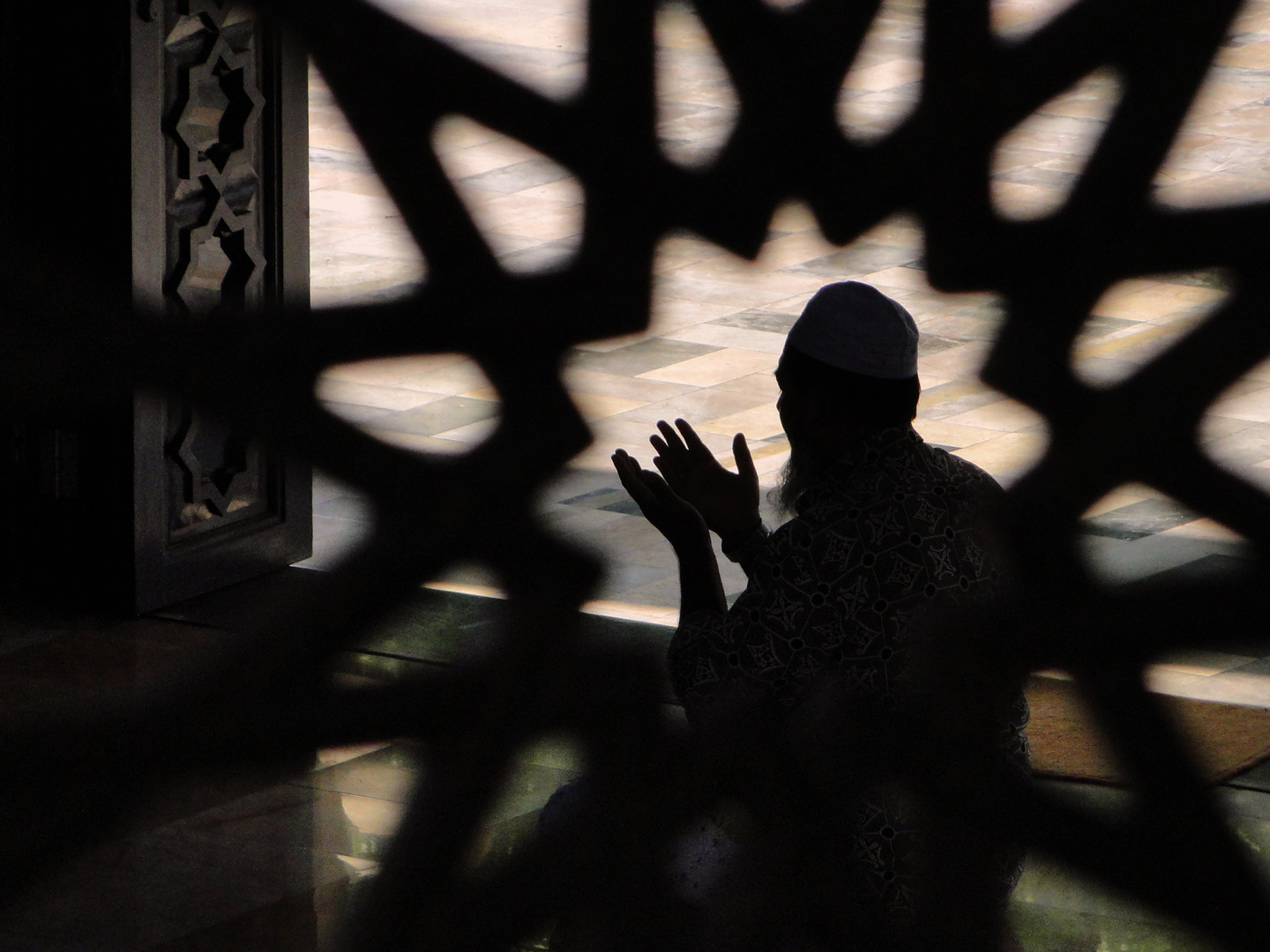
Salah is the daily ritual prayer enjoined upon all Muslims as one of the five Pillars of Islam
 It is performed five times a day by all Muslims.  Salah is a precise worship, different from praying on the inspiration of the moment.  Muslims pray or, perhaps more correctly, worship            
 five times throughout the day:
·        Between first light and sunrise.
·        After the sun has passed the middle of the sky.
·        Between mid-afternoon and sunset.
·        Between sunset and the last light of the day.
·        Between darkness and midnight.


Each prayer may take at least 5 minutes, but it may be lengthened as a person wishes.  Muslims can pray in any clean environment, alone or together, in a mosque or at home, at work or on the road, indoors or out.  Under special circumstances, such as illness, journey, or war, certain allowances in the prayers are given to make their offering easy.
Having specific times each day to be close to God helps Muslims remain aware of the importance of their faith, and the role it plays in every part of life.  Muslims start their day by cleaning themselves and then standing before their Lord in prayer.  The prayers consist of recitations from the Quran in Arabic and a sequence of movements: standing, bowing, prostrating, and sitting.  
All recitations and movements express submission, humility, and homage to God.  The various postures Muslims assume during their prayers capture the spirit of submission; the words remind them of their commitments to God.  The prayer also reminds one of belief in the Day of Judgment and of the fact that one has to appear before his or her Creator and give an account of their entire life.  This is how a Muslim starts their day.  In the course of the day, Muslims dissociate themselves form their worldly engagements for a few moments and stand before God. 
 This brings to mind once again the real purpose of life.
These prayers serve as a constant reminder throughout the day to help keep believers mindful of God in the daily stress of work, family, and distractions of life.  Prayer strengthens faith, dependence on God, and puts daily life within the perspective of life to come after death and the last judgment.  As they prepare to pray, Muslims face Mecca, the holy city that houses the Kaaba (the ancient place of worship built by Abraham and his son Ishmael).  At the end of the prayer, the shahada (testimony of faith) is recited, and the greeting of peace, “Peace be upon all of you and the mercy and blessings of God,” is repeated twice.
Though individual performance of salah is permissible, collective worship in the mosque has special merit and Muslims are encouraged to perform certain salah with others.  With their faces turned in the direction of the Kaaba in Mecca, the worshipers align themselves in parallel rows behind the imam, or prayer leader, who directs them as they execute the physical postures coupled with Quran recitations.  In many Muslim countries, the “call to prayer,” or ‘Adhan,’ echo out across the rooftops.  Aided by a megaphone the muezzin calls out:
Allahu Akbar (God is the greatest),

Ash-hadu an-laa ilaaha ill-Allah (I witness that none deserves worship except God).

Ash-hadu anna Muhammad-ar-Rasool-ullah (I witness that Muhammad is the messenger of God).

Hayya ‘alas-Salah (Come to prayer!)

Hayya ‘alal-Falah (Come to prosperity!)

Allahu Akbar (God is the greatest),

La ilaaha ill-Allah (None deserves worship except God).


Friday is the weekly day of communal worship in Islam.  The weekly convened Friday Prayer is the most important service.  The Friday Prayer is marked by the following features:
·        It falls in the same time as the noon prayer which it replaces.
·        It must be performed in a congregation led by a prayer leader, an ‘Imam.’ It can not be offered individually.  Muslims in the West try to arrange their schedules to allow them time to attend the prayer.
·        Rather than  a day of rest like the Sabbath, Friday is a day of devotion and extra worship.  A Muslim is allowed normal work on Friday as on any other day of the week.  They may proceed with their usual activities, but they must break for the Friday prayer.  After the worship is over, they can resume their mundane activities.
·        Typically, the Friday Prayer is performed in a mosque, if available.  Sometimes, due to unavailability of a mosque, it may be offered at a rented facility, park, etc.
·        When the time for prayer comes, the Adhan is pronounced  The Imam then stands facing the audience and delivers his sermon (known as khutba in Arabic), an essential part of the service of which its attendance is required.  While the Imam is talking, everyone present listens to the sermon quietly till the end.  Most Imams in the West will deliver the sermon in English, but some deliver it in Arabic.  Those who deliver it in Arabic usually deliver a short speech in the local language before the service.
·        There are two sermons delivered, one distinguished from the other by a brief sitting of the Imam.  The sermon is commenced with words of praise of God and prayers of blessing for Prophet Muhammad, may the mercy and blessings of God be upon him.
·        After the sermon, the prayer is offered under the leadership of the Imam who recites the Fatiha and the other Quranic passage in an audible voice.  
When this is done, the prayer is completed.
Special, large congregational prayers, which include a sermon, are also offered at late morning on the two days of festivity.  One of them is immediately following the month of fasting, Ramadan, and the other after the pilgrimage, or hajj.
Although not religiously mandated, individual devotional prayers, especially during the night, are emphasized and are a common practice among pious Muslims.

The First Pillar (faith or shahada).


The Shahada is the Muslim profession of faith and the first of the ‘Five Pillars’ of Islam.  The word shahada in Arabic means ‘testimony.’  The shahada is to testify to two things:
 -  Nothing deserves worship except God (Allah).
-  Muhammad is the Messenger of God (Allah).
A Muslim is simply one who bears witness and testifies that “nothing deserves worship except God and Muhammad is the messenger of God.” One becomes a Muslim by making this simple declaration.


It must be recited by every Muslim at least once in a lifetime with a full understanding of its meaning and with an assent of the heart.  Muslims say this when they wake up in the morning, and before they go to sleep at night.  It is repeated five times in the call to prayer in every mosque.  A person who utters the shahada as their last words in this life has been promised Paradise.
Many people ignorant of Islam have misconceived notions about the Allah, used by Muslims to denote God. Allah is the proper name for God in Arabic, just as "Elah", or often "Elohim", is the proper name for God in Aramaic mentioned in the Old Testament.  Allah is also His personal name in Islam, as "YHWH" is His personal name in Judaism. However, rather than the specific Hebrew denotation of "YHWH" as "He Who Is", in Arabic Allah denotes the aspect of being “The One True Deity worthy of all worship”.  Arabic speaking Jews and Christians also refer to the Supreme Being as Allah.

- Nothing deserves worship except God (Allah).

The first part of this testimony states that God has the exclusive right to be worshipped inwardly and outwardly, by one’s heart and limbs.  In Islamic doctrine, not only can no one be worshipped apart from Him, absolutely no one else can be worshipped along with Him.  He has no partners or associates in worship.  Worship, in its comprehensive sense and all its aspects, is for Him alone.  God’s right to be worshipped is the essential meaning of Islam’s testimony of faith: Lā ‘ilāha ‘illā llāh.  A person becomes Muslim by testifying to the divine right to worship.  It is the crux of Islamic belief in God, even all of Islam.  It is considered the central message of all prophets and messengers sent by God - the message of Abraham, Isaac, Ishmael, Moses, the Hebrew prophets, Jesus, and Muhammad, may the mercy and blessings of God be upon them.  For instance, Moses declared:
“Hear, O Israel The Lord our God is one Lord.” (Deuteronomy 6:4)
Jesus repeated the same message 1500 years later when he said:
“The first of all the commandments is, “Hear, O Israel; the Lord our God is one Lord.” (Mark 12:29)
…and reminded Satan:
“Away from me, Satan!  For it is written: Worship the Lord your God, and serve Him only.” (Matthew 4:10)
Finally, the call of Muhammad, some 600 years after Jesus, reverberated across the hills of Mecca, ‘And your God is One God: there is no god but He.’ (Quran 2:163).  
They all declared clearly:
“Worship God!  You have no other god but Him.” (Quran 7:59, 7:73; 11:50, 11:84; 23:32)
But by a mere verbal profession alone, one does not become a complete Muslim.  To become a complete Muslim one has to fully carry out in practice the instruction given by Prophet Muhammad as ordained by God.  This brings us to the second part of the testimony.

- Muhammad is the Messenger of God (Allah).

Muhammad was born in Mecca in Arabia in the year 570 CE.  His ancestry goes back to Ishmael, a son of Prophet Abraham.  The second part of the confession of faith asserts that he is not only a prophet but also a messenger of God, a higher role also played by Moses and Jesus before him.  Like all prophets before him, he was a human being, but chosen by God to convey His message to all humanity rather than one tribe or nation from among the many that exist.  For Muslims, Muhammad brought the last and final revelation.  In accepting Muhammad as the “last of the prophets,” they believe that his prophecy confirms and completes all of the revealed messages, beginning with that of Adam.  In addition, Muhammad serves as the preeminent role model through his life example.  The believer’s effort to follow Muhammad’s example reflects the emphasis of Islam on practice and action.

jeudi 27 février 2014

The Creator?


At first:Can It Be Matter?

A very popular question among atheists is, ‘Granted that the existence of temporal things necessitates the existence of an eternal cause, why should that cause be the God of religion?  Why can’t matter be eternal and be therefore in no need of an eternal creator?’ 


 I shall argue, on an Islamic basis but at the same time also on a rational basis, that the attribute of eternity entails other attributes, which matter does not and cannot have, and cannot, in view of this, play the role of the original and ultimate cause of temporal things.  Muslim theologians say that eternity of existence logically implies everlastingness.  This is true because, if something is eternal then it does not depend for its existence on anything outside itself.  If this is so then it can never pass away, because only those things pass away that lose some of the external conditions on which they depend for their existence.  If the ultimate cause of temporal things is eternal and everlasting, it must of necessity be self-sufficient, [in Arabic] qayyoom and ghanee.


mercredi 26 février 2014

Arkanul-Islam: The Five Pillars Of Islam (The Actions)


1.      Shahadatain (Testimony): To bear witness that there is none worthy of worship except Allah (The Creator), and thatMuhammad (sallAllahu ‘alaihi wa sallam) is His Messenger.Muslims are obliged to follow his exemplary life as a model.
2.      Salaah: Daily prayers are offered five times a day as a duty towards Allah . They strengthen and enliven the belief in Allahand inspire man to a higher morality. They purify the heartand prevent temptation towards wrong-doings and evil things. They are:
                               I.            Salaatul-Fajr (The Dawn Prayer)
                           II.            Salaatul-Dhuhr (The Noon Prayer)
                        III.            Salaatul-Asr (The Afternoon Prayer)
                        IV.            Salaatul-Maghrib (The Sunset Prayer)
                            V.            Salaatul-Isha (The Evening Prayer)

3.      Zakaah (Charity): The literal and simple meaning of Zakaah is purity, while its technical meaning designates the annual amount in kind or cash that a Muslim with means must distribute among the rightful beneficiaries from his yearly net savings. But the religious and spiritual significance of Zakaah is much deeper and more valuable than its humanitarian, andsocio-political value.

4.      Sawm (Fasting): The Muslims during the month ofRamadhaan do not only abstain from food, drink and sexual intercourse from dawn to sunset but they are also required to refrain from evil intentions and desires throughout the whole months of the year in general, and during the month ofRamadhaan in particular. It teaches love, sincerity and devotion, and develops a sound social conscience, patience, selflessness and will power as well.
5.      Hajj (Pilgrimage to Mecca): It is to be performed once in a lifetime, so long as one can afford it financially and physically, and it is the largest annual convention of faith where Muslims meet to know one another, study their common affairs and promote their general welfare without prejudice or bias as to one's color, race, nationality as well as status in life. After all, everyone is equal in the sight of Allah , and so Hajj therefore demonstrates in effect the universality of Islam and the brotherhood and equality of Muslims.

Arkaanul-Eeman: The Fundamental Articles Of Faith In Islam(The Beliefs)


The true faithful Muslim believes in the following principal articles of faith:


1.      Belief in one God (Allah ), Supreme and Eternal, Infinite and Mighty, Merciful and Forgiving, the Creator and the Provider, He begets not, nor was He begotten, and there is none equal or comparable unto Him.

2.      Belief in all Messengers of Allah (Ar-Rusul) without any discrimination among them, as every known nation had a Warner or Messenger from Allah . They were chosen by Allahto teach humanity and deliver His Divine message. TheQur'aan mentions the names of some of them, andMuhammad (sallAllahu ‘alaihi wa sallam) stands as the Last Messenger and the crowning glory of the foundation of prophethood.

3.      Belief in all original scriptures and revelations of Allah (Al-Kutub), accepting them as the guiding light that the messengers received to show their respective people the right path to Him. In the Qur'aan, special reference is made to the books of Abraham, Moses, David and Jesus (‘alaihimus salaam), but long before the revelation of the Qur'aan toMuhammad (sallAllahu ‘alaihi wa sallam) some of these books and revelations had been lost or corrupted. The only authentic and complete book of Allah in existence today is the Qur'aan, which has been preserved as it was revealed to Prophet Muhammad (sallAllahu ‘alaihi wa sallam) in its pristine, pure form.

4.      Belief in the Angels (malaa-ikah) of Allah , recognizing them as spiritually pure and splendid beings whose nature requires no food, drink or sleep. They are honored servants who are assigned certain functions, and spend their days and nights in the worship of Allah . They do not speak before Allah does, and they act only by His command.


6.      Belief in Fate (Qadr), whether good or bad, which Allah , measured and ordained for all creation according to His previous knowledge, and as deemed suitable by His wisdom. And in the timeless knowledge of Allah , and in His power to plan and execute His plans, nothing could happen in His Kingdom against His will. His knowledge and power which are always in action command over His creation. He is Wise and Merciful, and whatever he does must have a meaningful purpose. If this is established in our minds and hearts, we should accept with good faith all that He does, although we may fail to understand it fully, or think it is bad.


Faith without action and practice is a dead end as far as Islam is concerned, for faith by nature is very sensitive and can be most influential. When it is out of practice or out of use, it quickly loses its liveliness and motivational power.

We gone study all of this point on detaills INSHALLAH.